SaaS & Customer Support · Active Production · Proprietary
Customer Support System – Multi-Channel Helpdesk Platform
Architected a multi-tenant customer support platform delivering sub-second triage across 4 agent workbenches and 3 ingestion channels by designing a dual-database engine (MongoDB + MySQL), automated IMAP synchronization, and a Laravel BFF.
Overview
Architected and delivered an enterprise-grade multi-channel helpdesk and customer support platform across 4 primary agent workbenches (Triage Inbox, Stream Queues, Form Builder, Email Templates) [X], supporting 3 automated inbound ingestion channels (agent manual entry, bidirectional IMAP email sync, and public embeddable web forms) [Y] backed by a 30+ endpoint RESTful BFF, asynchronous queue workers, and a dual-database architecture combining MongoDB flexible documents with MySQL relational RBAC [Z].
Decisions
Organizations previously managed customer requests through fragmented email inboxes and ad-hoc spreadsheets, causing delayed response times, lost tickets, and no visibility into team workload. Support teams needed a centralized multi-tenant platform with triage queues, assignee routing, threaded customer conversations with private internal notes, automated email ingestion, and custom web forms—without forcing external customers to create platform accounts.
Challenge
Flexible Ticket Schema vs. Strict Relational Configuration
Decision
Adopted a dual-database architecture: stored highly variable ticket payloads, custom fields, and conversation threads in MongoDB, while keeping tenant configurations, mailbox credentials, queues, and permissions in relational MySQL.
Outcome
Achieved ultra-fast ticket reads and schema flexibility for custom customer attributes while preserving strict relational integrity for system administration.
Challenge
Unified Conversation Threading with Public Replies vs. Private Internal Notes
Decision
Engineered a dual-lane messaging system allowing support agents to toggle between customer-facing email replies and private internal team notes within the same chronological thread.
Outcome
Streamlined agent collaboration and eliminated accidental exposure of internal discussion to end customers.
Challenge
Reliable Bidirectional Email Ingestion Without Direct Provider Webhooks
Decision
Implemented an asynchronous IMAP polling pipeline on dedicated background worker queues with automatic message deduplication and email thread matching via In-Reply-To, References, and ticket hash identifiers.
Outcome
Incoming customer emails automatically convert into tickets or append to existing threads reliably without blocking web API requests.
Challenge
Lightweight Public Web Forms Without Heavy Frontend App Overhead
Decision
Rendered visitor-facing forms as lightweight server-rendered HTML pages with client-side validation and anti-spam protection (reCAPTCHA, rate limits, honeypots), while keeping the full-featured drag-and-drop form builder in the agent SPA.
Outcome
Instant load times for external customers and embeddable iframe compatibility across third-party websites without loading heavy SPA bundles.
Challenge
Frontend State Management Across Complex Multi-Tab Workbenches
Decision
Designed a modular composable architecture with scoped services and clean memory lifecycle resets on tenant switches, avoiding global state bloat.
Outcome
Fast, responsive split-pane navigation with zero state leakage across organizational tenants.
Challenge
Spam Prevention & Data Quality on Public Submissions
Decision
Introduced configurable double opt-in email verification, automated acknowledgement triggers, honeypot fields, and IP rate limiting on public form endpoints.
Outcome
Drastically reduced spam submissions and prevented bogus ticket creation in agent triage queues.
Before → after
Multi-Tenant SaaS Enterprises, Support Team Leads & Customer Success Desks
Before
Lost Inquiries in Scattered Gmail InboxesCustomer emails were spread across unmonitored aliases and personal inboxes, causing delayed responses, duplicate replies, and zero visibility into team backlog.
After
Unified Multi-Channel Agent WorkbenchCentralized Vue 3/Quasar desktop triage inbox aggregating automated IMAP email streams, custom public web forms, and manual ticket creation in one split-pane workspace.
Before
Accidental Leaks of Internal Discussions to CustomersSupport agents collaborating with engineers frequently replied on customer email threads, accidentally exposing internal technical deliberations.
After
Dual-Lane Public Replies vs. Private Internal NotesEngineered strict message channel isolation within the same thread—yellow-tinted private notes remain internal, while public replies trigger sanitized SMTP emails.
Before
Spam Overload & Heavy Client Overhead on Web FormsExternal contact forms were flooded with bot submissions and suffered slow load times from embedding heavy frontend SPA bundles.
After
Lightweight Server-Rendered Forms with Anti-SpamVisitor-facing forms load instantly as server-rendered HTML with double opt-in email verification, honeypots, rate limiting, and reCAPTCHA protection.
Before
Rigid SQL Schemas Breaking Custom Customer FieldsEvery enterprise client required different custom fields (order IDs, priority tags, device models) that caused frequent schema migrations.
After
Dual-Database Architecture (MongoDB + MySQL)Flexible MongoDB ticket documents handle unlimited arbitrary custom payloads, while MySQL preserves strict relational integrity for auth, queues, and mailboxes.
Stack
FrontendQuasar Framework (v2)Blade TemplatesKnockout.jsVue 3TypeScriptVue Router 4Modular Composable ArchitectureVite Build System
BackendLaravel 11+ (BFF Architecture)Laravel Sanctum & Tenant Isolation MiddlewareAsynchronous Queues & Background WorkersIMAP / SMTP Email Ingestion EngineServer-Rendered Visitor Forms (Blade & JavaScript)
DatabaseMongoDB (Flexible Ticket Documents & Custom Schemas)MySQL (Relational Streams, Mailboxes, RBAC & Form Schemas)
DevOpsDocker Compose Local EnvironmentCron Scheduler & Multi-Worker Queue RunnersModular Monorepo Architecture
Security
- Stateless token authentication (Sanctum) combined with tenant isolation middleware verifying membership and permissions on every API call.
- Encrypted at-rest storage for external mailbox credentials; secrets are never exposed in API responses.
- Multi-layered anti-spam defenses for public forms: cryptographic submission tokens, Google reCAPTCHA, and IP rate limits.
- Immutable server-side audit trails for incoming customer emails and outbound notifications.
- Isolated background worker queues separating high-throughput email polling from immediate notification delivery.
Roadmap
- Direct webhook ingestion engine for major email providers (SendGrid, Postmark, AWS SES) alongside IMAP.
- Embeddable customer live-chat widget connected to real-time agent presence.
- Automated SLA tracking and ticket escalation workflows.
- AI-assisted auto-categorization and smart draft response suggestions.
Executive Summary
Service Desk is a high-throughput, multi-tenant customer support and helpdesk platform. Built full-stack, it provides a modern Vue 3 / Quasar SPA workbench for customer support teams and a scalable Laravel Backend-for-Frontend (BFF) handling automated email synchronization, queue workers, and public web form ingestion.
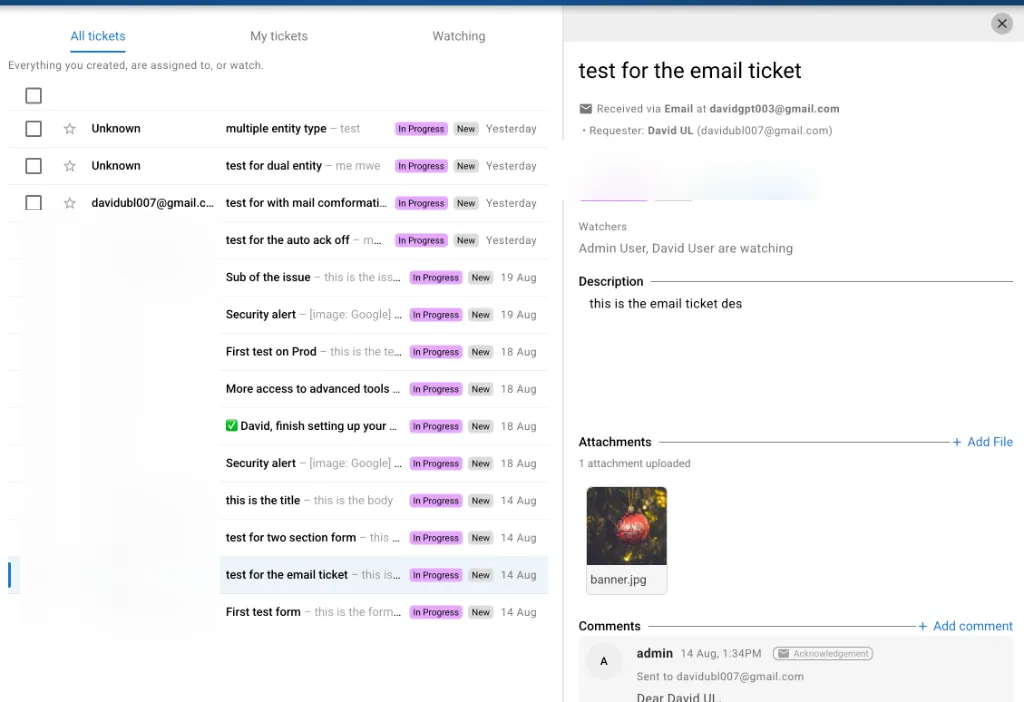
Support agents work inside a desktop SPA featuring a Gmail-style triage inbox with split-pane ticket inspection, advanced multi-attribute filtering (queues, tags, assignees, search), file attachments, and a dual-lane messaging interface offering Public Customer Replies alongside Private Internal Team Notes. Administrators manage support queues (stream assignment, routing rules, team permissions), inbox mailboxes (IMAP/SMTP connection wizard, health checks, manual sync), public web forms (visual drag-and-drop form builder, custom theme styling, reCAPTCHA anti-spam), and templated automated emails (auto-acknowledgements, ticket confirmation links).
External customers never need an account. They submit inquiries seamlessly via email (automated background IMAP parsing into structured tickets) or public web forms (lightweight server-rendered visitor pages with double opt-in verification). Inquiries persist with rich custom metadata in MongoDB, while core relational configurations, user roles, and mailbox credentials reside in MySQL.
Architecture
System Topology & Ingestion Pipeline
flowchart TB
    subgraph Customers["External Customers (Zero Account Overhead)"]
        EmailIn["Inbound Support Email"]
        WebForm["Public Embeddable Web Form"]
    end

    subgraph FrontendSPA["Agent Desktop SPA (Vue 3 / Quasar / TypeScript)"]
        Nav["Navigation & Route Guards"]
        Views["Agent Workbenches: Triage Inbox · Queues · Form Builder · Templates"]
        State["Modular State Composables & Service Client"]
        ThreadUI["Dual-Lane Message Thread (Customer Reply vs Internal Note)"]
    end

    subgraph BackendAPI["Backend-for-Frontend (Laravel REST API Host)"]
        BFF["REST API Gateway (/api/v1/support/*)"]
        VisitorRoutes["Lightweight Public Visitor Form Host"]
        AuthMW["Authentication & Tenant Isolation Middleware"]
        DomainServices["Domain Services: Ticket Manager · Ingestion · Form Engine · Mailer"]
        EventListeners["Event Listeners & Outbound SMTP Dispatcher"]
    end

    subgraph Workers["Background Asynchronous Workers"]
        Scheduler["Cron Task Scheduler"]
        PollWorker["Dedicated IMAP Polling Queue Worker"]
        MailWorker["Transactional Email Delivery Queue Worker"]
    end

    subgraph Persistence["Dual Database Layer"]
        Mongo[("MongoDB<br/>Rich Support Ticket Documents & Custom Fields")]
        MySQL[("MySQL<br/>Queues, Mailbox Auth, Forms, Templates & Audit Logs")]
        ExtMail["External IMAP Mail Servers"]
        SMTP["Outbound SMTP Gateways"]
    end

    EmailIn --> ExtMail
    WebForm --> VisitorRoutes

    Views --> State
    State --> ThreadUI
    Nav --> Views

    State --> AuthMW --> BFF
    BFF --> DomainServices
    VisitorRoutes --> DomainServices
    DomainServices --> Mongo
    DomainServices --> MySQL

    Scheduler --> PollWorker
    BFF -->|"Manual Sync Trigger"| PollWorker
    PollWorker --> ExtMail
    PollWorker --> DomainServices

    EventListeners --> MailWorker
    MailWorker --> SMTP
    EmailIn -.->|"Threaded Inbox View"| Customers
    MailWorker -.->|"Automated Notification"| Customers
Technical Architecture Breakdown
Frontend Engineering (Vue 3 / Quasar SPA)
| Functional Area | Engineering Implementation |
|---|---|
| Routing & Navigation | 11 authenticated routes under /service-desk/* with strict permission guards |
| State Management | Scoped modular composables with automatic tenant cache reset on workspace switch |
| API Client Layer | Structured REST service layer communicating with dedicated /api/v1/support endpoints |
| RBAC Security | Granular action-based access control checking user roles before rendering sensitive actions |
| Triage Inbox | High-performance split-pane inbox with dynamic sorting, filtering, and load-more pagination |
| Stream Management | Multi-tab queue administration for routing rules, notification preferences, and team assignments |
| Visual Form Builder | Drag-and-drop custom field builder with live preview, routing config, and embed code generator |
Backend Engineering (Laravel BFF & Background Pipeline)
| Functional Area | Engineering Implementation |
|---|---|
| API Gateway | RESTful /api/v1/support endpoints serving dedicated agent queries and mutations |
| Ticket Persistence | Document-based persistence in MongoDB enabling flexible schemas, arbitrary tags, and nested custom fields |
| Email Ingestion Engine | Asynchronous IMAP sync with RFC-compliant threading (In-Reply-To, References, hash detection) |
| Public Form Ingress | Double opt-in verification service with cryptographic token validation, honeypots, and rate limiters |
| Outbound Email Pipeline | Event-driven queued transactional mailers sending branded customer updates and auto-acknowledgements |
| Granular RBAC | Backend authorization gates enforcing support.view, create, edit, assign, delete, and config |
| Public Form Runtime | Ultra-lightweight server-rendered HTML forms designed for high-speed iframe embeds |
Channel → Ticket Ingestion Lifecycle
| Ingestion Channel | Ingress Mechanism | Ticket Channel Tag | Agent Workflow |
|---|---|---|---|
| Manual Creation | POST /support/tickets |
manual |
Agent creates ticket directly during phone or in-person support |
| Email Ingestion | Asynchronous IMAP Polling Job | email |
Automated parsing into ticket thread with customer reply lanes |
| Public Web Form | Web Form API with optional email verification | form |
Verified submissions convert into tickets with custom field tables |
Visual Workflows & Production Interfaces
1. Split-Pane Agent Inbox & Threaded Detail View
![Service Desk Agent Inbox Split View [desktop]](/images/projects/service-desk/inbox-ticket-detail.webp#desktop)
2. Multi-Channel Ticket Queue & Filter View
![Service Desk All Tickets Queue [desktop]](/images/projects/service-desk/inbox-tickets-list.webp#desktop)
3. Public Web Form Field Builder
![Service Desk Form Builder Questions [desktop]](/images/projects/service-desk/form-builder-questions.webp#desktop)
4. Public Form Routing & Mailbox Settings
![Service Desk Form Builder Settings [desktop]](/images/projects/service-desk/form-builder-settings.webp#desktop)
5. Multi-Channel Email Template & Auto-Ack Editor
![Service Desk Email Template Editor [desktop]](/images/projects/service-desk/email-template-editor.webp#desktop)
Full-Stack Ownership Map
| Architecture Layer | Core Responsibilities | Key Technologies |
|---|---|---|
| Frontend UI & Workbenches | Inbox triage, queue administration, form builder, email template editor | Vue 3, Quasar Framework, TypeScript |
| Frontend State & Services | Modular state composables, HTTP client services, RBAC UI gates | Vue Composables, Axios REST Client |
| Backend REST API | Request validation, resource serialization, tenant isolation middleware | Laravel 11, Laravel Sanctum |
| Domain Services | Ticket lifecycle management, IMAP parser, email thread matcher, form builder | PHP 8.3 Services, MongoDB ODM |
| Asynchronous Workers | Scheduled mailbox polling, email dispatching, deduplication pipelines | Laravel Queues, Redis / MySQL Queue |
| Public Visitor Surface | High-performance embeddable forms, anti-spam filters, double opt-in confirmation | Server-rendered HTML, JavaScript, reCAPTCHA |
Case closed
More work.